There are moments when life looks reasonable from the outside, but something feels wrong on the inside.
You may be doing what is expected of you. You may be working hard, caring for your family, supporting friends and trying to make sensible decisions. Yet you feel tired, restless, frustrated or disconnected from the person you once were. You may know that something needs to change without knowing exactly what the problem is.
That is often where people begin searching for a new job, a new relationship, a new routine or a completely new life. Sometimes an external change is necessary. But before you decide what to leave, fix or pursue, there is a more fundamental place to begin:
Who are you when you are not simply reacting to pressure?
The answer is not a job title, a family role or a list of things you have achieved. It begins with understanding what makes you feel alive, what matters deeply to you, what you need in order to thrive and what happens when those needs are ignored.
In other words, it begins with your values.
At Coachingandlife, we see this as a connected journey. You understand who you are. You identify the values that shape your choices. You notice how those values appear in your work and relationships. You recognise how stress changes your behaviour. Then you choose the level of support that helps you move forward with greater clarity.
It is not a collection of unrelated tests and programs. It is one connected chain from self-awareness to new action.
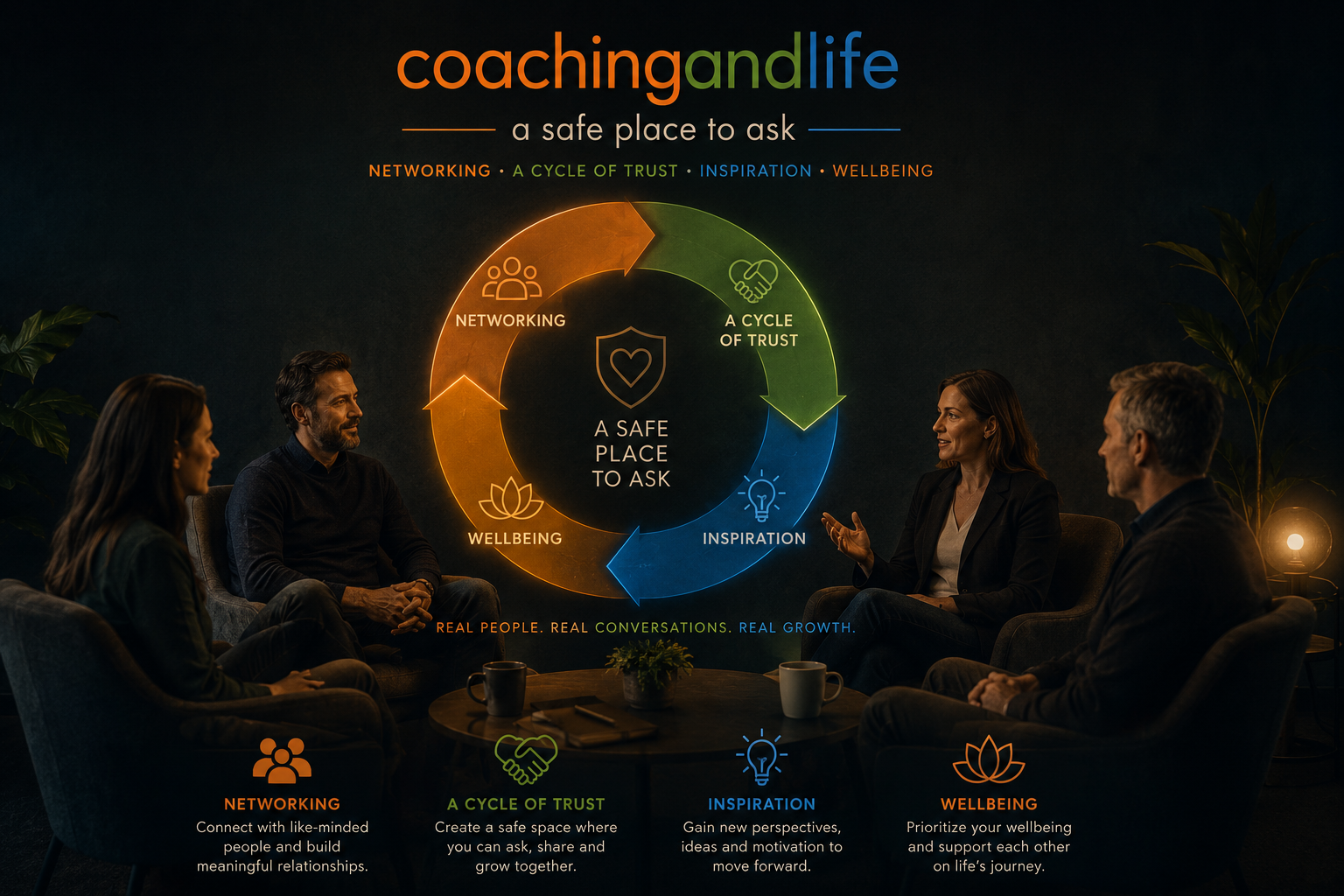
The Coachingandlife chain from pressure to clarity
WHO AM I?
WHAT BRINGS ME ALIVE?
WHY DOES IT MATTER?
HOW DO I LIVE MY VALUES?
WHAT CHANGES UNDER STRESS?
TAKE THE TWO FREE TESTS
CHOOSE YOUR SUPPORT
NAVIGATE DIFFERENTLY
Knowing who you are is more practical than it sounds
“Who are you?” can sound like a philosophical question. In daily life, it is intensely practical.
Your answer influences the work you accept, the behaviour you tolerate, the people you trust, the boundaries you set and the goals you pursue. It shapes whether success feels meaningful or strangely empty. It affects how you raise your children, how you handle disagreement and whether you can hear another person’s needs without abandoning your own.
Roles matter, but they can change. A job can end, children grow up and relationships shift. Your values provide a deeper foundation: they reveal what you want your life to stand for, even when the circumstances change.
If freedom is central to you, you may flourish when you have autonomy and become drained when every decision is controlled.
If loyalty matters deeply, you may build strong and lasting relationships, but stay too long in situations that repeatedly hurt you.
If achievement drives you, you may create extraordinary results, yet find it difficult to rest without feeling guilty.
If harmony is essential, you may calm a room and connect people, but sometimes silence your own voice to avoid conflict.
No value is automatically good or bad. Each value contains energy, a gift and a potential pressure point. Self-awareness helps you use the gift without becoming trapped by the pattern.
This is why a personal values test should do more than give you an attractive list of words. It should help you recognise how your values actually operate in your life.
Your values become visible in every part of life
Values are not abstract ideals that belong on a poster. They become visible through behaviour.
At work, your values influence what motivates or drains you. Excellence may be energised by high standards, creativity by the freedom to shape a solution, and fairness by an even distribution of workload and opportunity. When an environment repeatedly blocks these needs, engagement can fall.
You may still perform well, but something inside begins to withdraw. You may lose energy, question yourself or feel increasingly disconnected from your purpose.
In a relationship, one person may experience reliability as love, while another needs honest conversation to feel close. A third person may need personal freedom, not because they care less, but because autonomy is part of how they remain emotionally present.
In family life, an argument about punctuality may really involve respect. A disagreement about money may involve security for one person and freedom for another. Tension about family traditions may be a clash between loyalty, belonging, independence and change.
With children, your values influence both what you teach and what you fear.
Achievement can encourage discipline and opportunity, but it can also create anxiety when a child chooses a slower or less conventional path. Protection can create safety, but it can also make it difficult to step back and allow the child to develop confidence through experience.
Understanding your values allows you to ask an important question:
Am I supporting this person, or am I asking them to calm my own fear?
Friendships reveal values too. You may need depth rather than frequent contact, shared adventure rather than long conversations, or loyalty that survives difficult seasons. When you understand this, you can communicate what matters instead of expecting other people to guess.
This insight can change a conversation.
Instead of saying, “You never understand me,” you may be able to say:
“Reliability matters deeply to me. When plans repeatedly change without a conversation, I feel that our agreement does not matter.”
The second statement gives the other person something real to understand and respond to.
Many conflicts are values clashes in disguise
When two values meet, they can complement each other or collide.
A leader who values speed may become impatient with an employee who values accuracy.
A partner who values financial security may experience the other person’s spontaneity as irresponsibility. The spontaneous partner may experience careful planning as control.
A parent who values tradition may believe they are protecting belonging, while an adult child who values independence feels unseen or restricted.
Without values awareness, each person may decide that the other is difficult, selfish or wrong. With awareness, the conversation becomes more precise.
Ask:
- What value am I trying to protect?
- What value might the other person be protecting?
- What behaviour is genuinely unacceptable?
- Where is there room for a different preference?
- What boundary or agreement would respect both people?
Understanding another person’s values does not mean surrendering your own.
Empathy is not agreement. Tolerance is not permission for repeated disrespect.
Values coaching helps separate three situations that are easily confused: a difference, a conflict and a harmful pattern.
A difference may require curiosity.
A conflict may require negotiation.
A harmful pattern may require a firm boundary, outside support or a decision to leave.
When you can see the difference, you spend less energy arguing about the surface while the real issue remains unnamed.
Stress can introduce you to a different version of yourself
You do not always respond the same way when you are calm and when you are under sustained pressure.
When you feel safe and balanced, you may be open, thoughtful, patient and able to see several options.
Under stress, your attention can narrow. You may become irritable, withdraw, over-explain, control details, avoid decisions, work harder, please everyone or react more sharply than you intended.
This is not an excuse for hurtful behaviour. It is information that helps you recognise your pattern and take responsibility earlier.
The NHS overview of stress explains that stress can affect how people feel, think and behave. It can include difficulty concentrating, struggling with decisions, feeling overwhelmed, becoming irritable or avoiding people and places.
The World Health Organization also explains that stress is a natural response to difficult situations, including insecure work and conflicts with colleagues, friends or family.
Stress often pushes a valuable quality towards an unhelpful extreme:
- Responsibility becomes carrying everything alone.
- Excellence becomes perfectionism.
- Loyalty becomes enduring what repeatedly diminishes you.
- Care becomes rescuing everyone while neglecting yourself.
- Independence becomes refusing support.
- Harmony becomes silence.
- Control becomes an attempt to eliminate every uncertainty.
- Achievement becomes the belief that your worth depends on your output.
This is why values awareness and stress awareness belong together.
Your values show what matters to you. Your stress pattern shows what may happen when what matters feels threatened.
If you assess only your values, you may understand your best intentions but miss the behaviour that appears under pressure.
If you assess only your stress, you may recognise the symptoms but not understand why particular situations affect you so deeply.
Together, the two perspectives give you a more honest picture of who you are, what you need and what may need to change.
Begin with two free tests, not a dramatic decision
When you feel trapped in a corner, the urge to make one decisive move can be strong.
You may want to leave, confront someone, withdraw completely or force an immediate solution. But clarity is usually built through smaller and better questions.
Coachingandlife therefore begins with two free reflection tools.
The first is the Who Are You Really? Values Profile.
It helps you identify the values that most strongly shape how you choose, connect, work and respond. Your result is not a fixed personality label. It is a starting point for reflection: where you come alive, what you need and where your strengths may become pressure patterns.
Start with the free Who Are You Really? Values Profile.
The second is the free Stress Check.
It helps you look at your current level of pressure and notice where stress may be appearing in your thoughts, body, mood or daily load.
The results become especially useful when you place them beside each other.
Ask yourself:
- What do I value when I feel like myself?
- Which situations repeatedly challenge those values?
- What changes in my behaviour when pressure rises?
- What do I do to protect myself: fight, withdraw, please, control, avoid or overperform?
- What would a more aligned response look like?
These tools are coaching and self-reflection resources. They are not medical, psychological, psychiatric or diagnostic assessments, and they do not replace care from a qualified health professional.
Choose the depth of support you need
Insight is valuable. Application is where life begins to change.
Some people need a structured way to explore their values and practise new questions. Others need deeper dialogue because they are facing a real situation involving work, a partner, family, children or a repeated pattern they cannot see clearly alone.
Coachingandlife offers two levels of support, allowing you to choose the depth that fits your situation.
Level 1: Guided values coaching through 52 Ways
The 52 Ways Values Coaching Program is a structured, AI-guided journey through 52 human values.
Each value is explored through five practical lenses:
- What does this value mean to you?
- How do you express it?
- Why do you need it?
- What does it unlock in your life?
- What happens when it is missing or challenged?
This level is for the person who wants a clear framework, honest reflection and the flexibility to work at their own pace.
Over time, you begin to identify your core values and build a decision framework you can use at work, at home and in your relationships.
The aim is not simply to know that you value loyalty, freedom, kindness or success. It is to see what the value asks of you in a real situation this week.
Knowing that fairness matters to you is insight. Recognising how to respond when you experience unfairness is navigation.
Knowing that loyalty matters is insight. Understanding when loyalty strengthens a relationship and when it keeps you trapped is navigation.
Knowing that harmony matters is insight. Learning how to create harmony without making yourself disappear is navigation.
Level 2: Premium coaching dialogue for real-life navigation
The 52 Ways Premium level is for the moments when understanding the pattern is not enough.
A value may be challenged by a colleague, partner, friend or family member. You may know that a situation feels wrong but struggle to express why. You may need support to distinguish between compromise, self-abandonment and a necessary boundary.
Deeper coaching dialogue helps you work with the situation as it is actually happening.
The purpose is not to tell you what to do. It is to help you read the values in the room, understand your reaction, see your options and choose a response you can stand behind.
You learn to ask:
- What is happening beneath the words?
- Which value is being challenged?
- What belongs to me, and what belongs to the other person?
- What can be discussed or negotiated?
- What requires a clear boundary?
- What action would allow me to respect myself afterwards?
The two levels are not measures of strength. They provide different amounts of structure and support.
Choose the level that helps you turn insight into action without creating even more pressure.
You may not need to change every person around you
When an environment feels belittling, controlling or emotionally draining, it is natural to focus on changing the other person.
You may explain more, try harder, become quieter or wait for them to understand. If nothing changes, you can feel increasingly powerless and trapped.
Coaching begins in the part of the situation where you have agency:
How you recognise the pattern.
How you respond.
What you communicate.
What you no longer participate in.
What boundaries you set.
What support you seek.
You may not be able to change another person’s values or behaviour. But you can change your navigation.
That may mean pausing before answering instead of reacting immediately.
It may mean refusing to defend yourself against every accusation.
It may mean naming the behaviour without attacking the person.
It may mean asking for a clearer agreement.
At work, it may involve documenting a repeated pattern, involving a manager or HR, or seeking professional advice.
It may also mean deciding that an environment no longer deserves access to your energy, commitment or future.
Changing your navigation does not always mean staying in the same environment.
The WHO’s guidance on mental health at work identifies bullying, harassment, discrimination, limited support and organisational cultures that enable negative behaviour as workplace risks.
Individual coping skills can help you respond more clearly, but they do not remove an organisation’s responsibility to address harmful conditions.
The same principle applies in private life.
Coaching can support self-awareness, boundaries and decision-making. It should never be used to persuade someone to remain in an abusive or unsafe situation.
If you fear for your safety or experience threats, violence or coercive control, seek qualified local help and create a safety plan with an appropriate professional or support organisation.
The purpose of coaching is not to make you better at tolerating what harms you. It is to help you recover your perspective, your voice and your ability to make intentional choices.
A different response begins with a small pause
You do not need to redesign your entire life today.
Begin with one situation that repeatedly takes your energy.
Ask yourself:
What happened?
Describe only what could have been seen or heard. Separate what happened from the story your mind created around it.
What did I feel?
Name the emotion without judging it. Were you hurt, angry, afraid, disappointed, ashamed or overwhelmed?
Which value felt threatened?
Was it respect, trust, freedom, security, fairness, belonging or something else?
What did stress make me do?
Did you attack, retreat, please, freeze, control, overwork or abandon your own need?
What would an aligned response protect?
Your dignity, the relationship, a boundary, a practical outcome or your safety?
What is one next action?
A conversation, a pause, a request, a written agreement, outside support or a decision?
This short sequence creates space between the trigger and your response. In that space, you begin to lead yourself again.
Over time, the questions become a new way of navigating.
You recognise that your strongest reaction is not always your clearest truth.
You learn that another person’s values can be different without invalidating yours.
You stop treating every uncomfortable feeling as a command to act immediately.
You also stop dismissing repeated discomfort when it is showing you that an important boundary is being crossed.
Who you are becomes visible in what you choose next
Knowing yourself is not about finding one perfect label.
It is about developing enough clarity to recognise what strengthens you, what diminishes you and how you want to respond.
Your values help you understand what makes life meaningful.
Your stress pattern helps you recognise when pressure is steering your behaviour.
Coaching helps you translate that insight into conversations, boundaries and decisions.
That is the Coachingandlife chain:
Know who you are. Understand what matters. Recognise what stress changes. Choose support. Navigate differently.
You do not have to wait until you are certain about the whole future.
Start by becoming honest about the present.
Take the free Who Are You Really? Values Profile and complete the free Stress Check.
Place the two results beside each other. Look for the connection between what matters to you and what happens when it comes under pressure.
Then choose the support that fits your next step: explore your values through 52 Ways or use Premium coaching dialogue to navigate a real situation.
You may not control every environment or every person. But with clarity, support and practice, you can change how you meet them — and how you choose what comes next.
Coaching disclaimer
The Coachingandlife Values Profile, Stress Check and coaching programs are educational coaching and self-reflection resources. They are not medical, psychological, psychiatric, clinical or diagnostic tools, and they are not substitutes for professional healthcare, therapy, legal advice or emergency support. Seek appropriately qualified help when your situation requires it.